
You spent ₹30,000 on a Google Ads campaign last month. The dashboard looked amazing — 847 clicks, 63 form fills, 9 email signups. Your agency sent a cheerful report with green arrows pointing up.
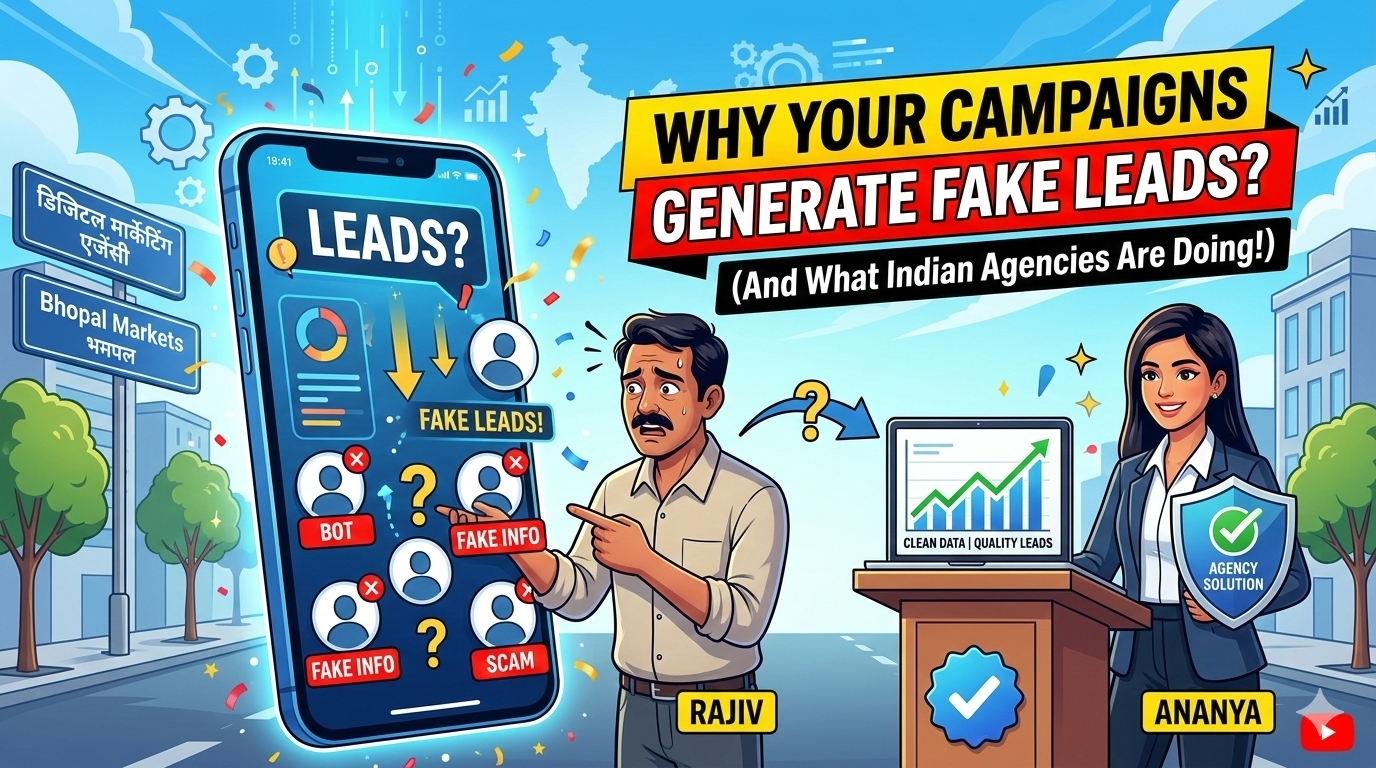
Then you called those leads.
Half the phone numbers didn’t exist. The emails bounced. Three people vaguely remembered clicking something but had zero interest in your product. Your actual sales from ₹30,000 in ad spend: two customers.
This isn’t your agency being incompetent. And it isn’t the ad platforms cheating you — though that’s a separate conversation. What destroyed your campaign ROI is a problem that sits quietly at the foundation of almost every Indian digital marketing campaign, and almost nobody talks about it directly.
Your campaigns are attracting people who never intended to be your customer.
The Fake Lead Epidemic in Indian Digital Marketing
Indian internet users are sophisticated. They’ve been burned by spam enough times to develop defenses.
When someone sees a “Get Free Consultation” or “Download Free Guide” offer, a large percentage of them want the thing — but they don’t want to hand over their real contact information to a business they’ve never dealt with. So they don’t. They submit a fake phone number. They enter an email address that doesn’t exist. Or they use a disposable email service that auto-deletes after the download is complete.
From your dashboard’s perspective: a lead. From a sales perspective: a ghost.
This problem affects every form of digital lead generation — landing page forms, webinar signups, free trial registrations, newsletter subscriptions, contest entries. Anywhere you ask for contact information in exchange for something, a percentage of respondents will submit false data.
In India, this percentage is higher than most agencies will tell you. The combination of spam culture, distrust of cold sales calls, and the sheer volume of promotional outreach people receive has trained a generation of internet users to protect their real identity by default.
Why This Is Getting Worse, Not Better
Three things are happening simultaneously that are amplifying this problem for Indian businesses:
More money is chasing Indian internet users. As digital ad spend by Indian businesses has grown dramatically over the past five years, the average person in urban and semi-urban India is now targeted by 40-50 ad interactions per day. Their defenses have become correspondingly stronger.
Lead generation templates are recycled everywhere. The “download this free guide” funnel, the “book a free consultation” CTA, the “enter your details for a chance to win” contest — these formats are so familiar that people recognize them immediately and engage with maximum caution. They know what happens next: the sales call, the email sequence, the WhatsApp follow-up. They want the free thing without the follow-up.
Verification steps are easy to bypass. Many businesses think requiring email verification solves the problem. It doesn’t. Disposable email services generate real, working temporary inboxes that receive verification emails perfectly — and then disappear. The “lead” verified their email. The email no longer exists. They have your free guide. You have a dead contact.
The Hidden Cost Nobody Calculates
When a digital agency presents your campaign report, they show you cost-per-lead. Say ₹475 per lead on 63 leads = ₹30,000 spent.
What they rarely show you is cost-per-qualified-lead — the number that actually matters.
If 40% of your leads were fake entries, your real lead count is 38. Your cost-per-qualified-lead is now ₹789. If only 60% of those actually match your customer profile, you have 23 viable leads at ₹1,304 each. If your sales conversion is 10%, you got 2-3 customers at a true acquisition cost of ₹10,000-₹15,000 per customer.
For many Indian small businesses, this math makes digital marketing look like a money pit. The problem isn’t digital marketing — it’s that nobody fixed the foundation.
What Smart Agencies Are Doing About It
The best digital marketing agencies in India are shifting from volume-based lead reporting to quality-based lead reporting. Here’s what that looks like in practice:
1. Email Verification at the Point of Capture
Before a lead enters your CRM, it should be checked against a database of known disposable email domains. This is a technical step that filters out temporary email addresses at the form level — the lead either submits a real email or doesn’t proceed.
This alone typically improves lead quality by 25-35% without changing a single word of your campaign creative.
2. Two-Step Verification That Actually Works
Standard email confirmation is insufficient because disposable emails pass it. Better verification involves checking whether the email domain has proper mail server records (MX records), has a history of engagement, and is not on a known throwaway domain list. This can be implemented server-side and is invisible to users with real emails.
3. Progressive Profiling Instead of Bulk Data Collection
Instead of asking for name, email, phone, city, business type, annual revenue, and team size in one form — ask for one thing at a time. Start with just an email. After engagement, ask for a phone number. After a call, ask for business details.
This approach dramatically reduces fake submissions because there’s no single-transaction payoff. People gaming lead forms are optimizing for a quick reward. Progressive profiling removes the incentive to fake.
4. Brand Authority Before Lead Generation
This is the highest-leverage fix and the least discussed. When someone already knows your brand and has seen you show up consistently — through content, social presence, Google rankings — they are far more likely to submit real contact information when they finally engage.
Lead quality is a brand awareness problem masquerading as a technical problem.
Before you launch lead generation campaigns, ask your agency what they’re doing to build organic brand recognition. Are you ranking for search terms your customers use? Is your Google Business Profile generating impressions? Does your brand name even feel distinct and trustworthy?
If not, your lead gen campaigns are marketing to cold strangers with zero trust — and strangers protect themselves.
The Brand Identity Problem Underneath It All
Here’s a deeper issue: many Indian businesses running digital campaigns have brand identities so generic that even genuinely interested people don’t take them seriously.
A business name that sounds like ten other businesses in the same city, a logo that looks like a stock template, no clear positioning — this communicates low investment and low credibility. People who submit real contact information are implicitly taking a risk: “I trust this business enough to give them a way to contact me.” Generic brands don’t earn that trust.
Before scaling any lead generation campaign, it’s worth auditing your brand from a new customer’s perspective. If your business name blends into the category, tools like an AI name generator can help you explore alternate brand identities or DBA names that give your digital marketing a distinctive anchor. A distinctive name is easier to remember, easier to search, and signals that a real business is behind the ads — not just another generic promotion.
A Practical Checklist for Better Lead Quality
If you’re currently running digital campaigns or about to start, run through this before your next campaign brief:
Technical fixes:
- [ ] Email domain validation enabled on all lead forms
- [ ] Phone number format verification active
- [ ] Known disposable email domains blocked at form level
- [ ] CRM auto-tagging leads by source for quality tracking
Campaign fixes:
- [ ] Forms collect minimum required fields only
- [ ] Progressive profiling implemented for high-value offers
- [ ] Lead magnet is specific and professional (not generic)
- [ ] Landing page has trust signals: testimonials, photos, specifics
Brand fixes:
- [ ] Business name is distinct and searchable
- [ ] Google Business Profile is complete with real photos
- [ ] Website has clear, specific service descriptions
- [ ] At least 5 verified Google reviews from real customers
Reporting fixes:
- [ ] Agency reports cost-per-qualified-lead, not just cost-per-lead
- [ ] Monthly call audit: what % of leads were contactable?
- [ ] Lead-to-meeting conversion tracked separately from lead volume
The Shift That Changes Everything
The Indian digital marketing landscape is maturing fast. Three years ago, running any digital campaign was enough to stand out. Today, your competitors in Tier 2 and Tier 3 cities are running the same campaigns, targeting the same audiences, making the same promises.
The businesses pulling ahead aren’t spending more. They’re spending smarter — which means starting with quality over volume, brand over noise, and systems that filter waste before it inflates a report.
Fake leads aren’t your agency’s fault. They’re a market-level problem that every business faces. But fixing them is entirely within your control — and fixing them is what separates campaigns that grow businesses from campaigns that generate impressive dashboards with nothing underneath.
Your next campaign brief should start not with “how many leads can we generate?” but with “how do we make sure the leads we generate are real?”
That question, asked clearly, will change everything about how your agency works for you.